ODB ++ Future v Gerber - or something else?
Printed From: PCB Libraries Forum
Category: PCB Footprint Expert
Forum Name: Questions & Answers
Forum Description: issues and technical support
URL: https://www.PCBLibraries.com/forum/forum_posts.asp?TID=579
Printed Date: 03 Jul 2026 at 3:14am
Topic: ODB ++ Future v Gerber - or something else?
Posted By: sgdavies
Subject: ODB ++ Future v Gerber - or something else?
Date Posted: 25 Sep 2012 at 7:38am
|
Hi I know its a bit off topic and off Application, but im really interested to know how many people here are using ODB ++ for manufacturing and how many people still use Gerber, and why? I am interested in early adoption of products, and how this benefits individuals and companies, I know people here have direct talks with IPC, and was wondering what IPC thinks if there will be a standardisation of manufacturing data, and if they think ODB++ will ever be agreed as a standard? Thanks and Regards, and don't shoot me for going off topic. Stephen.
|
Replies:
Posted By: Tom H
Date Posted: 25 Sep 2012 at 7:52am
|
PCB Libraries, Inc. is a member of the IPC-2581 Consortium - http://www.ipc2581.com/index.php/members-on-top" rel="nofollow - |
Posted By: sgdavies
Date Posted: 25 Sep 2012 at 7:59am
| Hi Tom, Thanks for your swift insight into the dilemma. I will look into IPC-2581 Consortium. |
Posted By: Tom H
Date Posted: 25 Sep 2012 at 10:20am
 Contact: Hemant Shah Cadence Design Systems, Inc Jamie Wise WISE Software Solutions, Inc First PCB Built Using the IPC-2581 Format
Reduces Fabrication Preparation Time by 30 Percent PCB
WEST, SANTA CLARA, Calif., September 25, 2012 – The IPC-2581 Consortium, the collective
group of PCB design and supply chain companies devoted to enabling,
facilitating and driving the use of IPC-2581 in the industry, announced today
that consortium members have fabricated the industry’s first PCB by
transferring the design data to manufacturing in the IPC-2581 format, while
reducing overall fabrication time by 30 percent. This is another big step forward
since the consortium validated the format earlier this year. The bare
board was fabricated with a PCB design from Fujitsu Network Communications. Fujitsu
exported the fabrication data contained within a single-file of the IPC-2581 format
from the Cadence® Allegro® PCB Editor. The assembly pallet was constructed and
the IPC-2581 data augmented and validated using VisualCAM from WISE Software. Finally, the bare board was fabricated by CC Electronics in the UK. This 12- layer bare board is a typical
optical plug-in module consisting of BGAs, QFPs and SFPs, components rotated at
odd angles, a series of complex milled cutouts, the use of split planes,
positive and negative plane layers, high speed nets with controlled impedance,
differential pair, and matched length constraints. “We received the entire PCB design in one
single file from Fujitsu, and fabricated the board with the help of Photo Data
who did the photoplotting for us,” said Phil Wain, Senior IT and Front End
Engineer of CC Electronics, UK. “The whole process of managing this data on our
side was very efficient; the time spent on this design was 30 percent less
compared to similar designs using traditional, multiple file formats to
describe the PCB design.” This industry’s
first PCB fabricated using IPC-2581 is a big milestone for the IPC-2581
Consortium, and also illustrates great advances for the whole PCB design and
supply chain industry toward improving efficiency and reducing costs, as well
as developing an independent, vendor-neutral and open standard. “The
process of working with WISE Software and CC Electronics was very smooth and
efficient,” said Gary Carter, Senior Manager, CAD Engineering Department at
Fujitsu Network Communications. “With IPC-2581 data from the Cadence Allegro
PCB Editor, there was no need for additional communications, iterations to
explain, edit, and update the design data.” The IPC-2581
Consortium will show this PCB fabricated using IPC-2581 at PCB West in Santa
Clara, California, on September 26 at the IPC-2581 Consortium booth
(#217). Additionally, at PCB West, consortium members will demonstrate how
their design/DFM/CAM tools produce/consume IPC-2581 based design data at the IPC-2581
Consortium booth, as well as at their own booths. Founded
in August 2011, the membership of IPC-2581 Consortium has grown to 36 PCB design
and supply chain companies. New members who joined the consortium in the past 6
months include Orbital Sciences Corporation, Polar Instruments, PTC, Qualcomm,
PCB Libraries, Cimnet, Cisco, Velux, Sedona International, Photo Data, CC
Electronics and more recently QLogic. In addition to advocating IPC-2581 as an
open, neutrally maintained global standard data transfer format though various
communication channels, another goal of IPC-2581 Consortium is to establish
confidence within the industry towards this new standard. A technical work
group was created to validate that the IPC-2581 data is identical and complete
for the fabrication, assembly, and test of printed circuit boards. An aggressive
three-phase test plan has been made and the http://pcdandf.com/cms/component/content/article/171-current-issue/9020-ipc-2581-consortium-validates-bare-board-fab-data" rel="nofollow - has already been successfully
completed. About IPC-2581 Consortim IPC-2581 Consortium is a group of PCB design and supply chain companies whose collective goal is to enable, facilitate and drive the use of IPC-2581 in the industry. It is devoted to accelerating the adoption of IPC-2581 as an open, neutrally maintained global standard to encourage innovation, improve efficiency, and reduce costs.Members
of the IPC-2581 Consortium include OEMs, EDA/DFM/CAM software companies, PCB
fabricators, electronics assemblers, and test companies. The Consortium is open
to any PCB design and supply chain company that is prepared to support or is
committed to a roadmap for IPC-2581 adoption. For more
information about IPC-2581 Consortium, please visit http://www.ipc2581.com/" rel="nofollow -
Cadence
and Allegro are registered trademarks of Cadence Design Systems, Inc. in the
United States and other countries. All
other trademarks are the property of their respective owners. |
Posted By: Mattylad
Date Posted: 25 Sep 2012 at 3:24pm
|
ODB++ might be used a bit more if there was a free viewer as good as GC-Prevue is for looking at Gerbers available.The Mentor viewer built on the back of the VUV is IMO clunky and non user friendly. IPC2581 will need the same thing and some viewers have already been made for it. |
Posted By: sgdavies
Date Posted: 26 Sep 2012 at 1:12am
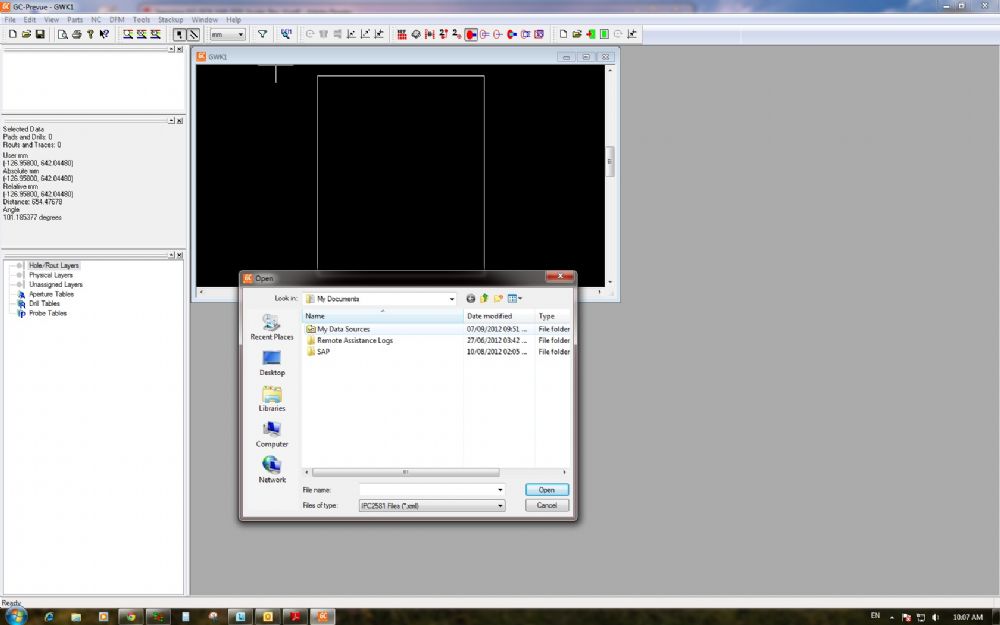 HI Matty, Just checking my latest install of GC Preview, seems like they already support
IPC2581 
UPDATE... I downloaded testcase 1 from the IPC website http://www.ipc-2581.com/index.php/ipc-2581-files" rel="nofollow - http://www.ipc-2581.com/index.php/ipc-2581-files
But GC Preview wouldn't open the file, so I downloaded the Free Vu2581 viewer and seems to work ok, but differently from GC Preview.
|
Posted By: Randy Clemmons
Date Posted: 26 Sep 2012 at 10:06am
|
I use 274X and never have a problem. I only provide ODB++ when specifically requested. Every fab house in the entire world can work from 274X. Once a project goes to higher volumes and the buyers start shopping around for alternate fab houses to use based on price and turn time you going to have fewer calls and problems if you go with good old 274x. |
Posted By: sgdavies
Date Posted: 27 Sep 2012 at 12:22am
| Hi Randy, I used to use 274X whilst working with Design Bureau's, but since working for larger companies, I have found its imperative to get DFM/DFA Reports before we go to manufacture, I have found this saves so much money on re-spins of the PCB's not to mention smoothing out the whole assembly process again saving money, Concerning ODB++ and the new IPC2581, simply by adopting it, you are saving time on front end work, it is estimating savings of 20-30 %, so all these savings add up if you have 1000's of units manufactured, Finally having an intelligent database opened by the manufacturer, its easy for them to run their own Manufacture/assembly rules on it and easily pass back "Volume DFM/DFA Report", this is the crux of the question for me. |
Posted By: jameshead
Date Posted: 01 Oct 2012 at 4:31am
|
After graduating in '94 my first job was as a CAM Engineer for Graphic in the UK before I left to become a PCB designer so I've seen a lot of different gerber outputs, extended and non-extended, from a lot of CAD systems. Your CAM Engineer has to pick up a datapack, translate it, tool it up, and chuck it out to the shop floor very quickly and move on to the next one. Whilst it's true that every fab house in the entire world can work from extended gerber it's not "pleaseant" to have to do so in the year 2012 when there are much better ways of doing things. I output an archive of gerber/excellon/gencad/IPC-356 netlist/centroid data as well as an ODB++, double-check each output in a viewer, and let my end customers choose what they want to use. Some of our fabricators offer discounts on tooling when we give them an ODB++ output and a couple encourage its use (both are Genesis CAM users). If Pulsonix add an IPC-2581 output then I'll probably switch over to it in preference to the ODB++ output. |
Posted By: abrakadabra
Date Posted: 23 Mar 2017 at 2:18pm
|
You probably know by now that Altium supports ODB++, and the open-source version IPC-2581, plus Gerber "X2". They are very progressive. |